The Door as Architectural Narrative
Within the realm of interior architecture, the frameless interior door has emerged as a potent canvas for architectural storytelling. Moving far beyond its primary role as a functional divider, the frameless door now encapsulates cultural narratives, material explorations, and spatial identity—embodying a fusion of art and architecture.
Tracing the Door’s Journey: From Frame to Frame-less
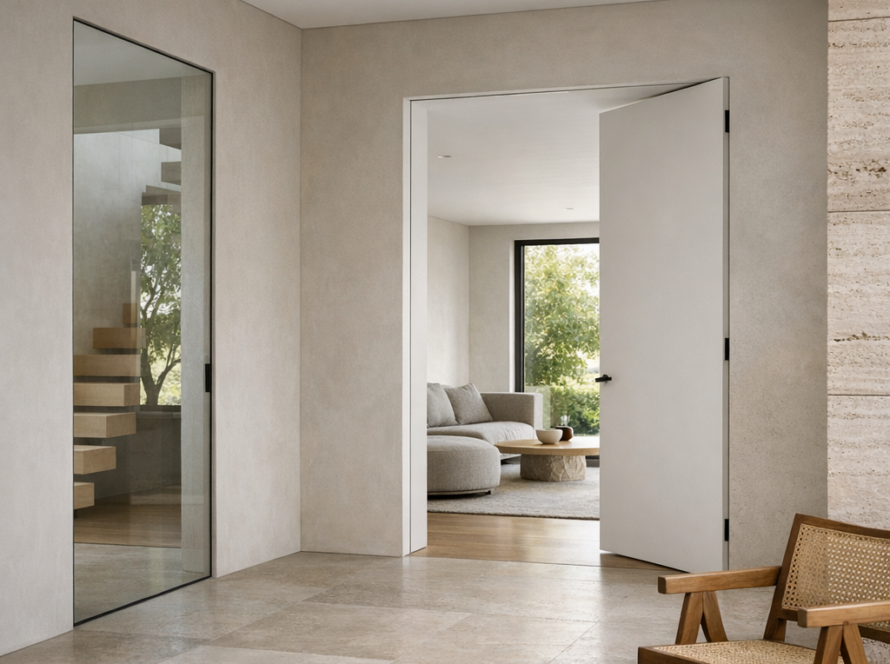
Traditionally, doors have served as boundaries, marked clearly by their visible frames and hardware. Frameless interior doors disrupt this visual language, emphasizing continuity and seamlessness. This architectural shift reflects broader movements in interior design, particularly the rise of minimalism and open-plan living, where permanence is expressed through fluid spatial connections rather than rigid visual separations.
The disappearance of a frame allows the door to become an unbounded surface, inviting architects and designers to innovate with finishes, textures, and materials. This evolution mirrors an architectural narrative where boundaries become ambiguous, encouraging occupants to interpret thresholds as moments of transition rather than mere separations.
Materiality as Narrative Medium
Material choices for frameless doors contribute significantly to their role as architectural storytellers. The emergence of advanced composites, high-performance glass, and refined wood veneers provides designers with an expanded palette to evoke particular atmospheres or cultural references.
- Glass and Transparency: Frameless glass doors invite light and visibility, symbolizing openness and connectivity. Different textures—such as frosted or tinted glass—add nuanced layers of privacy and mystery, shaping the spatial narrative in nuanced ways.
- Wood and Grain: Continuous grain wood doors, especially when veneered to extend across adjacent walls, blur boundaries and contribute a tactile narrative of warmth and natural elegance.
- Metallic Finishes: The use of matte or brushed metal surfaces can evoke industrial or futuristic stories, rooting interiors in contemporary urban sensibilities.
The Intersection of Surface and Story
Beyond material, surface treatments—including laser engravings, subtle patterns, or color gradients—introduce storytelling through visual and tactile codes. These details allow frameless interior doors to transform into architectural artifacts that embody the ethos or history of a dwelling, neighborhood, or cultural milieu.
Architectural Context and Spatial Identity
The role of frameless interior doors extends decisively into how interiors are experienced. By integrating these doors within specific architectural contexts, designers elevate the door to a spatial identity marker. For instance, a frameless door that aligns perfectly with wall panels evokes notions of purity and abstraction, while one that contrasts deliberately can highlight articulation and emphasis.
This spatial choreography reshapes how inhabitants transition between public and private zones, inviting reflection on privacy, flow, and openness. The architectural dialogue created by frameless doors is a language of thresholds, proposing invisible narratives that complement the broader interior architecture.
Contemporary Inspirations and Collaborations
Innovative collaborations between architects and artisans further push the expressive potential of frameless interior doors. Customized design features, inspired by site-specific elements or client stories, manifest as subtle yet profound narrative layers.
Exploring premium collections, such as those highlighted on DAYORIS, reveals how bespoke frameless doors combine technical precision with storytelling artistry. These designs underscore the potential of doors not just as components of spatial function but as evocative works of architectural craftsmanship.
Frameless Doors and the Future of Interior Narratives
As materials science and fabrication techniques advance, frameless interior doors will increasingly serve as dynamic storytellers within architectural practice. Their seamless form invites imaginative expression ranging from minimalism’s pure strokes to culturally rich, textured compositions.
Designers are challenged to harness this evolving potential, ensuring that frameless doors do more than conceal or reveal—they speak, they narrate, and they connect interiors to the human experiences they shelter.
For those interested in exploring a variety of frameless door designs and architectural inspirations, consider browsing the curated frameless door catalog to witness firsthand how architectural storytelling unfolds through these elegant portals.