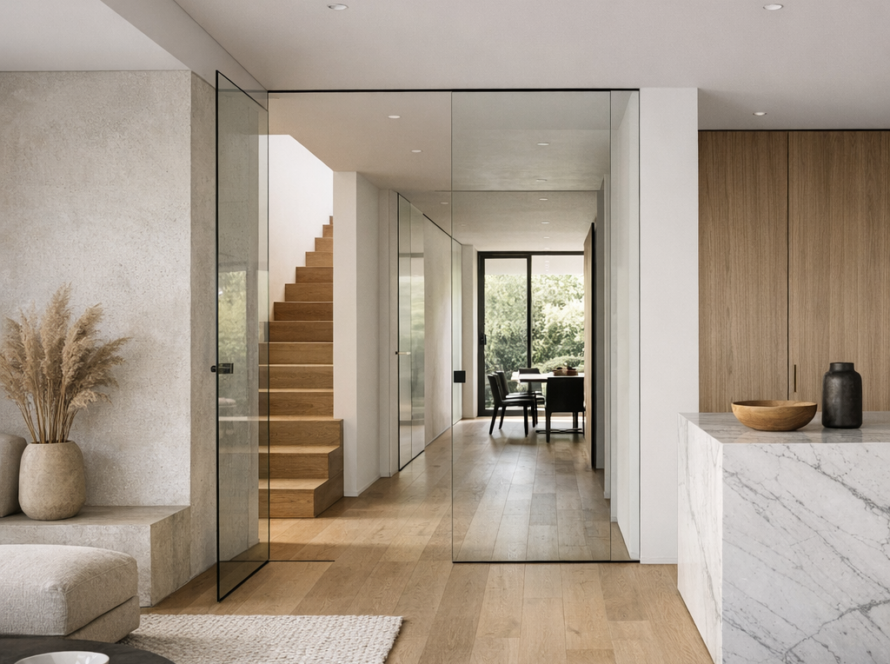
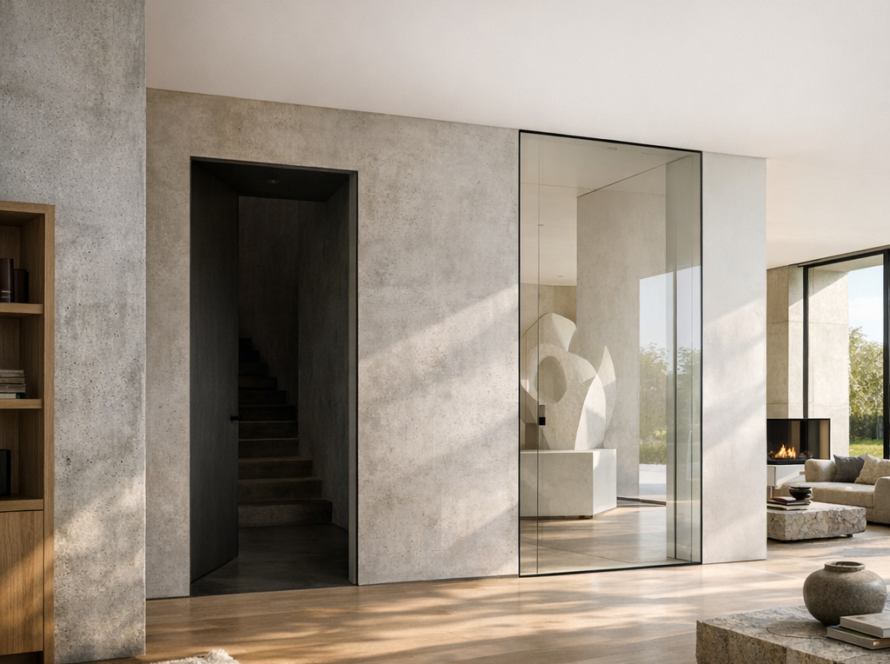
The Intersection of Architecture and Art: Introduction to Frameless Doors in Galleries
The evolving relationship between art and its architectural context profoundly impacts how visitors experience creativity and spatial flow. Frameless interior doors serve as an intriguing architectural element within contemporary art galleries, subtly influencing perception without detracting from exhibited works.
Far beyond mere functional partitions, these doors embody a commitment to seamless integration, minimal visual disruption, and refined materiality, aligning with the galleries’ ethos of purity and openness.
Minimalism and the Art of Concealment
Minimalist architecture in art spaces prioritizes unobstructed sightlines and the promotion of fluid circulation. Frameless interior doors, often employing concealed frames and hardware, enable walls to remain visually uninterrupted.
- Concealed Frames: These are embedded within the wall’s gypsum or plaster substrates, disappearing from view when closed, emphasizing uninterrupted planar surfaces.
- Flush Surfaces: Doors align perfectly with adjacent walls, allowing the architecture itself to recede and thus prioritizing exhibited pieces.
- Material Continuity: Commonly, doors share the same finish or texture as surrounding walls, such as matte paints or integrated wood panels.
This architectural technique supports the galleries’ narrative of quiet spaces that accentuate, rather than compete with, art.
Material Choices: The Dialogue Between Transparency and Opacity
Frameless doors in galleries are not limited to opaque panels. Variants include:
- Translucent Glass Doors: Use of frosted or acid-etched glass maintains light diffusion and spatial privacy without sacrificing a sense of openness.
- Textured Surfaces: Incorporating materials like etched metal sheets or finely grained wood panels can add subtle layered textures that reflect light and shadow.
- Innovative Composite Panels: Lightweight, sustainable composite materials can replicate traditional finishes while enhancing durability.
These material decisions directly affect how space is perceived, influencing atmosphere, visitor movement, and contextual framing of the art.
Spatial Fluidity: Opening Systems for Dynamic Exhibition Layouts
Art galleries frequently require adaptable spatial configurations to accommodate diverse exhibitions. Frameless interior doors enable versatile circulation through advanced opening mechanisms:
- Pivot Hinges: Moving the door around a fixed point allows for wide opening angles unobstructed by door frames, enhancing movement flow.
- Sliding Frameless Doors: Incorporating top-hung sliding systems with concealed rails allows doors to slide flush along or into walls.
- Concealed Pocket Doors: Entire door panels retreat into wall pockets, rendering walls visually continuous and expanding usable gallery floor space.
These systems, when paired with frameless design, maximize the feeling of open, uninterrupted spatial volumes central to modern gallery experiences.
Lighting Interaction: Subtle Enhancements via Architectural Details
Lighting profoundly shapes interior experiences in galleries where every detail contributes to atmospherics. Frameless interior doors affect and interact with lighting in several ways:
- Shadow Casting: Doors flush with walls minimize shadow lines, preserving an even light field.
- Light Diffusion: Translucent doors soften both natural and artificial light, creating ambient glow zones that complement artworks.
- Concealed Light Fixtures: The absence of frames allows for integrated LED strips along door edges or adjacent walls without visual interruption.
Through thoughtful lighting design, frameless doors become active contributors to the gallery’s spatial narrative.
Historical Resonances and Contemporary Relevance
The architectural principle of eliminating visual clutter can be traced back to modernist pioneers like Mies van der Rohe who promoted simplicity and material honesty. Frameless interior doors represent a contemporary evolution of these ideals, embodying technological and material advancements to meet present-day spatial and aesthetic demands.
Their application in galleries underscores a reverence for purity of form and function, while offering the flexibility required in spaces dedicated to ever-changing creative expressions.
Conclusion: Frameless Doors as Catalysts of Architectural Experience
In contemporary art spaces, frameless interior doors transcend utility to become architectural devices that shape perception, motion, and atmosphere. Their seamless integration fosters minimalistic elegance, reinforces material continuities, and accommodates dynamic spatial programs.
For those engaged in architectural or interior design of premium, culturally significant environments, understanding the poetics behind frameless door systems unlocks innovative pathways to harmonize structure and expression.
To explore design inspirations and premium door solutions, consider visiting the Dayoris collection, renowned for its architectural depth and modern craftsmanship.
For more insights into seamless interior architectural elements, please visit Frameless Interior Doors.