Introduction
In contemporary interior architecture, frameless interior doors have transcended traditional functional roles, becoming essential tools in shaping the spatial experience and architectural flow of residential environments. Beyond their sleek appearance, they influence how occupants navigate, perceive, and inhabit spaces, making circulation design an integral aspect of frameless door implementation.
The Role of Doorways in Architectural Circulation
Doorways and openings are more than mere passage points; they act as critical nodes that govern movement and transitions between different spatial zones. The design and placement of these elements affect the sequential perception of space, privacy gradients, and functional relationships within a dwelling.
Traditional doors, with visible frames and bulky hardware, often impose visual breaks, constraining line-of-sight and spatial continuity. Frameless interior doors, by contrast, facilitate smoother transitions, supporting a fluid and holistic spatial narrative.
Frameless Doors as Spatial Connectors
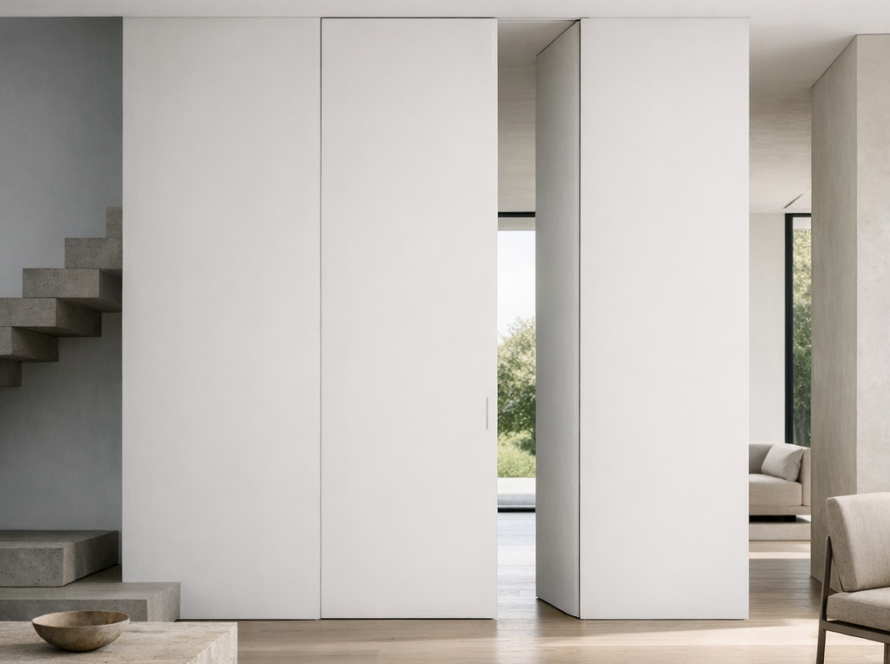
The absence of a frame in these doors eliminates visual interruptions, allowing rooms to appear interconnected even when separated by walls. This architectural strategy enhances the idea of continuity and can make even modest-sized homes feel larger and more cohesive.
Moreover, frameless doors can be configured to blend with wall finishes, including paint, wood veneer, or plaster, which further minimizes their presence and emphasizes uninterrupted surfaces.
Impact on Circulation Paths
Circulation paths are the routes people take to move through an interior. The placement and style of doors significantly influence these routes by guiding movement organically and reducing congestion.
- Visual Guidance: Frameless doors, by maintaining uninterrupted sightlines, help users intuitively understand pathways and room adjacencies.
- Spatial Hierarchy: Depending on the door’s opacity or transparency, designers can subtly delineate public from private zones without bulky partitions.
- Flexibility: Flush frameless doors can be paired with sliding or pivot hardware to optimize available space and adapt circulation flow dynamically.
Example: Open-Plan Living with Frameless Doors
In open-plan homes, maintaining a balance between openness and defined areas is critical. Frameless doors can act as optional barriers that do not disrupt the openness when open but create privacy when needed. For instance, a frameless pivot door between a living room and a private study can preserve visual flow yet afford acoustic separation.
Aesthetic and Psychological Dimensions
The minimalistic nature of frameless doors aligns with contemporary architectural philosophies that favor simplicity and purity of form. Their subtle presence encourages occupants to focus on spatial qualities rather than architectural interruptions.
Psychologically, the continuous wall surfaces and seamless transitions promoted by frameless doors can produce a calming environment, reducing the cognitive load associated with complex spatial boundaries.
Material Integration and Lighting
Frameless doors often leverage the play of light and materials to enhance circulation experience. Glass panels without visible frames, or opaque doors finished with tactile materials, can catch and diffuse natural or artificial light, guiding movement and atmosphere.
Considerations for Architects and Designers
- Door Placement: Thoughtful spatial analysis is crucial; doors should be positioned to support natural traffic flow without creating bottlenecks.
- Hardware Selection: Choosing minimal and reliable opening systems is essential to maintain the frameless aesthetic and ensure functionality.
- Wall Integration: Walls must be carefully detailed to conceal door edges and hinges seamlessly; precision in carpentry and finishes is critical.
For innovative design inspiration and premium frameless door solutions, architects can explore Dayoris’ selection of architectural interior doors that exemplify the potential for frameless doors to enhance circulation and spatial experience.
Conclusion
Frameless interior doors are pivotal architectural elements that redefine circulation and the spatial narrative in modern residential design. Their ability to promote fluid movement, preserve sightlines, and integrate with varied materials and finishes makes them indispensable for architects pursuing minimalist yet dynamic spatial experiences.
Understanding their influence on both the physical pathways and psychological perception of space can elevate interior design strategies, resulting in homes that are not only elegant but also intuitively navigable and serene.
Explore more about frameless design principles and exquisite collections at Frameless Interior Doors.