The Philosophy Behind Invisible Boundaries
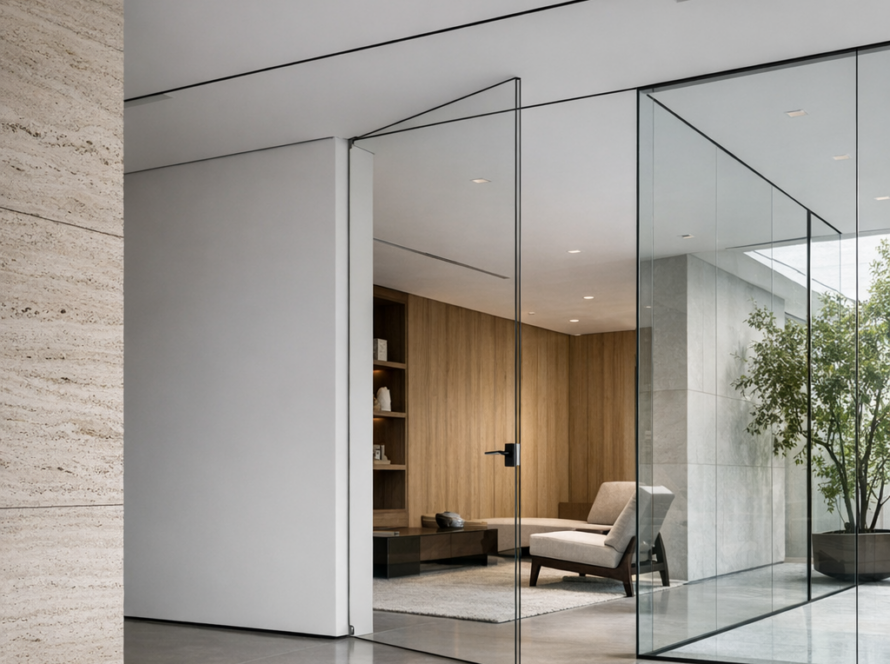
Minimalist architecture is not simply about reduction; it embodies a deliberate complexity where every element serves a purpose in balancing openness and seclusion. Frameless interior doors perfectly illustrate this philosophy by creating invisible boundaries that shape living spaces without interrupting the continuity of design.
Spatial Perception and Psychological Impact
Frameless doors allow light and form to flow uninterrupted, altering the perception of space. While traditional doors assert their presence through frames and casings, frameless doors melt into the wall plane. This subtlety creates a spatial dialogue where rooms can feel simultaneously defined and integrated, enhancing the psychological comfort that minimalist spaces strive for.
Architectural Integration: Beyond Functional Boundaries
The essence of minimalist design lies in undistracted surfaces and purity of form. Frameless interior doors contribute to this goal by acting as architectural features without articulation. No visible hinges, molding, or trim set them apart, allowing architects and interior designers to emphasize volume, texture, or color fields uninterrupted by door elements.
Material Harmony and Finishes
Selection of materials profoundly influences how frameless doors blend with interiors. Wood veneers matched perfectly to adjacent wall paneling or high-quality lacquer painted flush with the wall create a unified surface. Some contemporary approaches incorporate subtle differences in finish or tone to introduce an understated contrast while maintaining overall harmony.
Concealed Functionality within Minimalism
Despite their visual simplicity, frameless doors encompass advanced mechanical precision. Concealed hinges and magnetic or push-to-open systems preserve the illusion of absence, while sophisticated sealing solutions ensure privacy and environmental control. Thus, frameless doors reveal an intersection of technology and minimalist design intent.
Privacy Reconsidered
Minimalist open floor plans often raise concerns about privacy. Frameless doors provide a nuanced solution – they serve as subtle partitioning elements, respecting the architectural language without fragmenting the space visually or spatially. This allows architects to carve out quiet zones that coexist effortlessly with more public areas.
Frameless Doors as Articulators of Modern Spaces
Beyond residential applications, frameless interior doors resonate deeply within galleries, luxury retail, and office environments where spatial storytelling is key. Their presence is not just functional but conceptual, challenging perceptions about boundaries and transitions.
For homeowners and designers seeking inspiration, collections like Dayoris’ premium frameless doors provide exemplary models of seamless integration marrying high craftsmanship with minimalist ideals.
Final Reflections
Frameless interior doors symbolize more than architectural openings; they represent a design ideology that welcomes fluidity, subtlety, and intentional absence. Embracing these invisible boundaries elevates minimalist interior architecture by recasting what a door can be – not a barrier, but an integral element of spatial expression.
For further insights into frameless door systems and their architectural roles, visit Frameless Interior Doors.